The subjects change the BPC-157 story
A cut rat tendon, cells in a dish, a painful knee: putting them beside each other reveals how much a single recovery claim leaves out.
A tendon cut all the way through
The 2003 Achilles-tendon experiment used rats with fully transected tendons. The treated tendons recovered better on mechanical and functional measures; collagen was better organized, and the tendon ends joined more fully. Rat tendon cells also grew out from tissue in vitro, meaning in a laboratory preparation.
The mechanical tests and tissue examinations persuade me because they specify what improved. A stronger repaired tendon is a concrete result. It is also a result in rats with a deliberately created injury; clinical findings in people with years of tendon pain remain unestablished here.
Claims about BPC-157 benefits often widen to muscle building, weight loss or higher testosterone. The musculoskeletal review does not support those popular extensions. Repair of an injured tissue and growth of healthy muscle are different outcomes.
BPC-157 and the VEGFR2 experiment
The BPC-157 mechanism of action becomes more specific in the 2017 study of VEGFR2 activation and blood-vessel growth. It used the membrane around a chick embryo, a rat hindlimb with restricted blood supply, and human vascular endothelial cells grown in a dish. Vessel density increased, and blood flow recovered faster in the rat muscle.
Angiogenesis, the formation of new blood vessels, is the proposed connection. The researchers reported more VEGFR2 expression and internalization, with downstream Akt-eNOS signaling. Blocking endocytosis—the process by which cells take material inward—blocked the reported effect.
The interruption earns my confidence as a clue: it tests something more precise than whether a treated tissue looks better. Human cells in a dish still do not make this a human treatment trial.
A separate tendon-fibroblast study found increased growth-hormone receptor expression. BPC-157 is not growth hormone. This was a change in how cultured rat cells received its signal.

BPC-157 human pilot studies
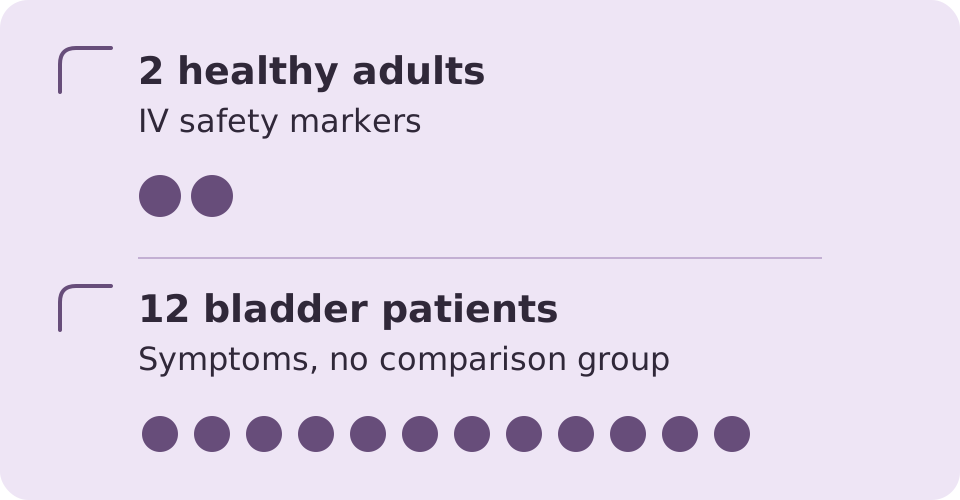
The 2025 intravenous safety pilot involved two healthy adults. It reported no observed adverse events and no measurable changes in cardiac, hepatic, renal, thyroid or glucose biomarkers. It did not test the repair of an injury. Healthy volunteers with steady safety markers cannot stand in for people with kidney or liver disease.
The 2024 interstitial-cystitis pilot included twelve patients. It reported complete symptom resolution in 10/12, with no reported adverse events, after BPC-157 was placed inside the bladder during cystoscopy. There was no comparison group. Interstitial cystitis is the bladder condition studied here; the paper does not establish treatment of kidney disease.
The knee-pain case series reported improvement across several pain types, also without a comparator. That leaves a real clinical question about arthritis unresolved: how much improvement came from the compound rather than the other things that change pain?
I oppose bundling these different reports as if each confirmed the others. A safety-marker study, a bladder-symptom report and a knee-pain report do not add up to one demonstrated recovery treatment.
BPC-157 vs TB-500 has no winner in these papers
BPC-157 and TB-500 are different compounds. The current record describes BPC-157 as the synthetic gastric fragment and TB-500 as a fragment of thymosin beta-4. No human head-to-head test in this record settles which works better.
The BPC-157 review documents the human-evidence gap; the FDA advisory agenda lists both compounds for discussion about bulk ingredients. Appearing together in conversation, or on an agenda, cannot supply the missing comparison. I have no basis for awarding either a clinical advantage here.